

Best places to photograph on Mykonos Island, Greece
Mykonos is much more than a trendy island in the Aegean Sea. Between white alleyways, Cycladic churches, wind-facing mills, and the deep blue of the sea, the island offers scenery that changes completely between the quiet sunrise and the illuminated night. For those who enjoy travel photography, Mykonos brings together light, architecture, and atmosphere in a rare combination.
What makes Mykonos Island special for photography
Mykonos has a very strong and immediately recognizable visual identity. The white cubic houses, the doors and windows painted in blue, red, or green, the narrow stone alleys, and the constant presence of the Aegean Sea create a setting that works very well in different photographic styles.
At sunrise, the soft light reveals texture details on the whitewashed facades, stone steps, and small chapels scattered throughout Chora. By late afternoon, the white buildings take on golden and pink tones, while the blue of the sea and sky becomes more intense. This combination of simple but highly contrasting colors makes Mykonos an especially interesting place for minimalist compositions, architectural photography, and urban travel scenes.
Another important element is the island’s constant wind. It moves fabrics, plants, flags, umbrellas, and even the sea itself, creating visual dynamism. On very windy days, the waves crashing against the rocks of Little Venice and around the mills provide more dramatic and energetic images.
Main scenery and photographic spots on the Mykonos Island
Kato Mili windmills
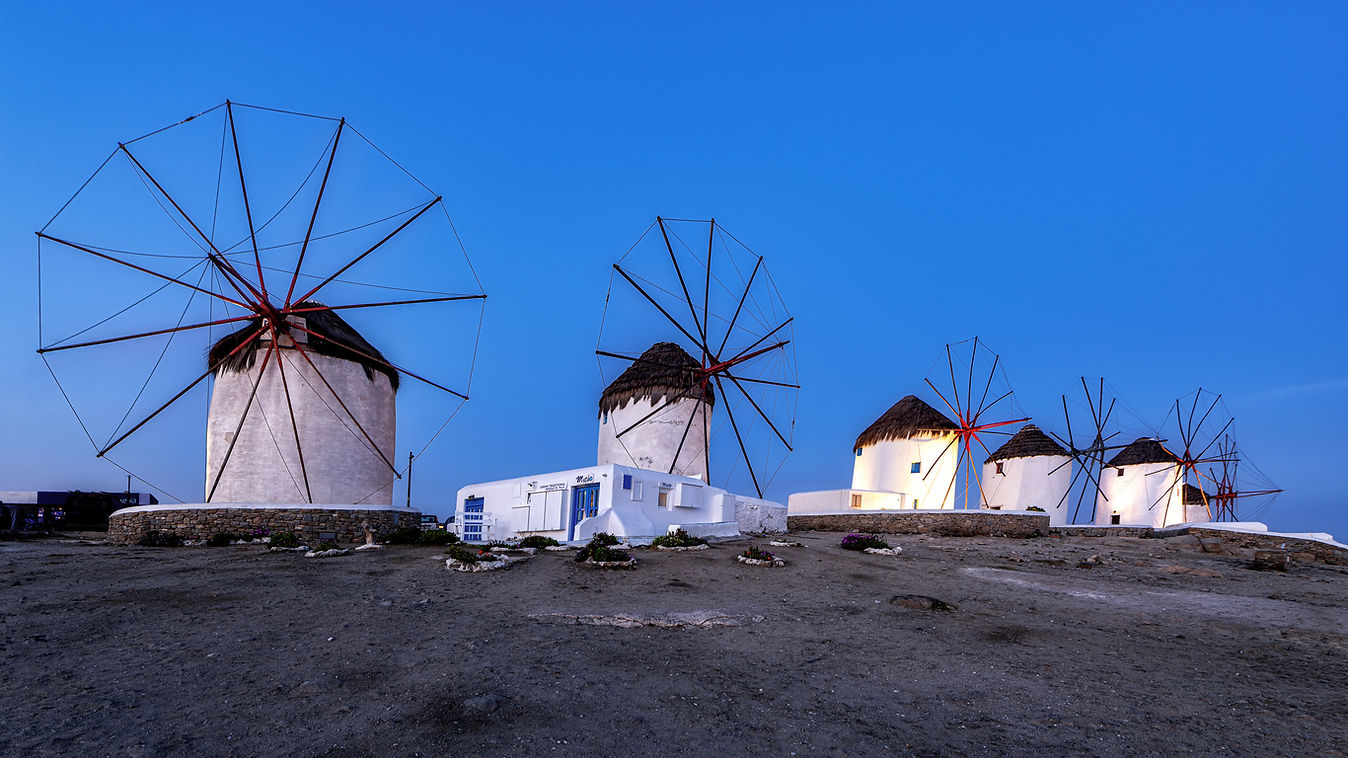
The Kato Mili windmills are the main postcard image of Mykonos. Built between the 16th and 19th centuries, they occupy a hill facing the sea and dominate the landscape of Chora. The best time to photograph them is right at sunrise, when the side light highlights the white texture of the cylindrical towers and the movement of the sails creates an interesting contrast against the blue sky.
From the hill, it is also possible to obtain wide panoramas of the white town descending toward the sea. With wider lenses, it is worth including the windmills, the houses, and the blue of the Aegean Sea in the same composition.
Little Venice at sunrise and at night
Little Venice is one of the most photogenic settings in Mykonos. The old houses built over the water, with wooden balconies and colorful facades, seem to float above the sea. At sunrise, the soft light creates delicate reflections on the stones and water, while also allowing the area to be photographed while still empty.
At night, the atmosphere changes completely. The amber lights of the bars and restaurants reflect on the rocky cove, creating a vibrant and cinematic scene. It is an excellent location for long exposures, especially when the sea is rougher and the waves turn into a soft and misty effect.
Panagía Paraportiani Church
Panagía Paraportiani Church is one of the most interesting buildings in Mykonos for architectural photography. Formed by the union of five chapels built over different periods, it has an irregular silhouette, with organic volumes and curved surfaces typical of Cycladic architecture.
The best way to photograph it is early in the morning or late in the afternoon, when the side shadows highlight its forms. Since the church is entirely white, days with an intense blue sky help create a simple and very striking composition.
Old port and Agios Nikolaos Church
The old port offers an interesting combination of fishing boats, crystal-clear water, and small historic churches. Agios Nikolaos Church, near the waterfront, is one of the highlights of the area, with its simple architecture and light-colored dome contrasting with the blue of the sea.
This is a good spot for more documentary-style photography, with fishermen, boats, seagulls, and everyday scenes from the island. In the early morning hours, movement is still limited and the light is usually softer.
The alleyways of Chora
The alleyways of Chora are perhaps the most versatile setting in Mykonos. Narrow stairways, flower pots, colorful doors, flower-covered balconies, and small decorative details create endless composition possibilities.
The interesting approach is to walk slowly and observe how the light enters the alleys throughout the day. In some places, shadow completely dominates the scene, creating strong contrasts between white and black. In others, a single beam of light illuminates a staircase or a blue door, producing minimalist and elegant images.
Panoramic views of Chora at sunset
At sunset, it is worth going up to the higher areas around the village to look for wide views of Chora. From these points, it is possible to frame the windmills, white houses, churches, and the Aegean Sea in a single image.
When the sun begins to set, the town takes on golden tones and the elongated shadows help add depth to the scene. After sunset, the sky usually remains illuminated for a few minutes in deep blue and orange tones, creating an excellent moment for panoramic photography.
Practical tips for photographing on the Mykonos Island
The best strategy for photographing Mykonos is to start before sunrise. The island receives many visitors throughout the day, and in the first hours of the morning it is possible to capture empty streets, silent windmills, and Little Venice with much more tranquility.
Sunset also deserves special attention. Climbing to the areas around the windmills or the hills near Chora allows you to capture wide panoramas of the village illuminated by golden light. A wide-angle lens is very useful for framing the set of houses, churches, and sea, while a telephoto lens helps compress landscape elements and highlight architectural details.
For night photography, Little Venice and the alleyways of Chora are the best spots. A lightweight tripod helps with longer exposures, especially for capturing reflections on the water and the glow of illuminated facades.
Because of the constant wind, it is worth protecting your equipment against dust and saltwater spray, especially near the windmills and along the coast. It is also important to observe the harsh midday shadows, which can be used creatively for more graphic compositions, exploring lines, stairways, arches, and strong contrasts between the white facades and colorful details.


